Skip to main
University-wide Navigation

Advanced Manufacturing

AM_01

Our lab develops scalable pathways to create compositionally complex thin films and nanomaterials using advanced manufacturing. We combine solution processing, electrochemical synthesis, and atmospheric-pressure plasma processing to access both equilibrium and nonequilibrium chemistries, enabling precise control over composition, bonding, and structure across multiple length scales.

We apply these methods to materials classes where complexity is fundamental to function, including hybrid organic–inorganic networks, high-entropy materials, and carbon-based materials. In these systems, performance emerges from structural descriptors spanning scales — valence complexity, chemical composition and heterogeneity, and nanoscale and mesoscale morphology. By tuning these descriptors through carefully designed synthesis pathways, we unlock emergent behaviors that conventional materials cannot achieve.

These manufacturing approaches naturally bridge scalable film deposition and rapid compositional exploration. They support large-area coating and integration with industrially relevant platforms, while also enabling combinatorial libraries that map how structure and chemistry evolve across gradients. This flexibility allows us to advance materials that are both fundamentally novel and practically deployable, accelerating their path from concept to real-world impact.

Atmospheric Pressure Plasma Processing

Atmospheric-pressure plasmas are partially ionized gases generated in air or flowing gas environments without vacuum systems. In these discharges, electrical energy is distributed among multiple reactive channels — including energetic electrons, ions, radicals, excited neutrals, photons, and localized thermal energy — allowing chemical reactions to proceed through diverse and tunable pathways. This rich energy partitioning enables access to nonequilibrium chemistries and bond-forming mechanisms that are not achievable through conventional thermal processing.

Atmospheric-pressure plasmas are powerful tools for surface treatment and functionalization, adhesion promotion, and thin film and nanomaterial synthesis. By tailoring discharge conditions, precursor delivery, and substrate environment, we can activate surfaces, graft functional molecular groups, or build compositionally complex coatings with nanoscale precision.

APPJ_01

Spray Coating

Spray coating is a scalable thin-film deposition method that delivers liquid precursors as micron-scale droplets, enabling uniform coverage over complex surfaces without vacuum infrastructure. In this process, fluid dynamics, droplet evaporation, solvent transport, and interfacial chemistry work together to form continuous films or patterned materials. By tuning precursor chemistry, solvent systems, droplet size, and substrate temperature, spray coating provides precise control over film thickness, composition, and microstructure.

This versatile technique enables thin-film and nanomaterial fabrication across large areas, making it compatible with traditional production lines as well as roll-to-roll. When coupled with reactive or post-processing environments — including drying, thermal curing, and plasma exposure — spray coating enables the formation of compositionally complex films with application-specific properties.

spraycoater

Electrochemical Synthesis

Electrochemical synthesis uses applied electrical potential to direct chemical reactions at solid–liquid interfaces, enabling precise control over composition, oxidation state, and microstructure in thin films and nanomaterials. By tuning voltage, current, electrolyte chemistry, and mass-transport conditions, we regulate ion transport, nucleation, growth kinetics, and defect incorporation, allowing atom-efficient pathways to tailored material architectures.

This approach provides access to compositionally complex coatings, multivalent oxides, metallic and hybrid films, and nanostructured phases — often at ambient temperature and pressure. Electrochemical processing also integrates naturally with patterning, templating, and other additive manufacturing workflows, supporting scalable production on conductive substrates and complex geometries.

Applications span catalysis, corrosion and hydrogen-barrier coatings, energy storage interfaces, and protective and functional surface layers, making electrochemical routes a powerful and sustainable platform for advanced materials manufacturing.

electrochemical_00

Advanced Characterization

advanced characterization

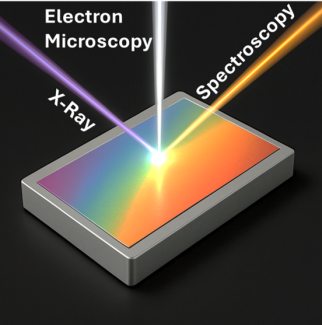
Understanding how structure gives rise to function requires probing materials across multiple length scales — from local atomic chemistry to extended microstructure. We integrate electron microscopy, x-ray scattering, and vibrational and x-ray spectroscopies to resolve structural motifs ranging from atomic coordination and bonding environments to nanoscale morphology and microscale morphology.

This multiscale toolkit allows us to quantify chemical speciation, molecular structure, crystallinity and disorder, defect populations, and microstructural evolution during synthesis and operation. By coupling structural insight with synthesis parameters and operational conditions, we capture the dynamic pathways that connect processing to structure and structure to performance.

Through this integrated approach, we build mechanistic understanding that accelerates materials discovery, guides compositional design, and ensures that our advanced manufacturing strategies produce systems optimized for real-world function.


Electron Microscopy

Electron microscopy allows us to visualize and quantify how structure and chemistry are organized across length scales in compositionally complex materials. By harnessing electron–matter interactions — including elastic scattering, inelastic scattering, and x-ray generation — we use scanning electron microscopy (SEM) to resolve morphology and microstructure with nanoscale precision.

Through energy-dispersive x-ray spectroscopy (EDS), we map elemental distributions and compositional gradients, revealing heterogeneity and local chemistry in systems where multiple elements and oxidation states play critical roles. Electron backscatter diffraction (EBSD) provides crystallographic information — grain size and orientation, phase distribution, strain features, and texture — linking synthesis parameters to microstructural evolution and performance.

This toolkit enables us to interrogate morphology, composition, and crystal structure within the same platform, giving a comprehensive view of how complex atomic arrangements and processing conditions shape functional behavior. These insights guide material design and ensure our advanced manufacturing strategies produce structures optimized for real-world performance.

SEM_00

X-Ray Scattering

X-ray scattering provides quantitative insight into how structure is organized across length scales in compositionally complex materials. Using x-ray diffraction (XRD) and wide-angle x-ray scattering (WAXS), we resolve crystal symmetry, lattice distortions, phase composition, and strain, capturing how atomic-scale order and disorder evolve with synthesis conditions. These signatures are especially important in systems where mixed coordination environments, valence states, and lattice frustration drive emergent behavior.

At larger length scales, small-angle x-ray scattering (SAXS) reveals nanostructure, porosity, and mesoscale morphology, enabling us to understand how nanoscale features, clusters, and interfaces contribute to functional properties. X-ray reflectivity (XRR) complements these techniques by measuring film thickness, density, interface roughness, and layer uniformity, providing precision insight into thin-film architecture and growth mechanisms.

Together, WAXS, SAXS, XRD, and XRR allow us to connect atomic-level motifs, nanoscale organization, and thin-film structure to performance. These tools form a core part of our multiscale characterization strategy, linking advanced manufacturing routes to the structural hierarchies that enable durable, high-performance materials.

XRD_00

Vibrational Spectroscopy

Vibrational spectroscopy provides direct insight into bonding environments, molecular structure, and local chemistry in complex materials. Using Raman spectroscopy, we probe lattice vibrations, carbon hybridization, defect signatures, and molecular functional groups, allowing us to distinguish bonding motifs, degree of order, and chemical heterogeneity in materials ranging from hybrid organic–inorganic networks to nanostructured carbons and metal–oxide systems.

Fourier transform infrared spectroscopy (FTIR) complements Raman by identifying vibrational fingerprints of organic linkers, surface functional groups, and inorganic coordination environments, making it a powerful tool for tracking reaction pathways, precursor chemistry, and post-processing transformations. Together, Raman and FTIR reveal how bonding, disorder, surface chemistry, and molecular architecture evolve during synthesis and treatment.

These techniques bridge the gap between atomic-scale bonding and larger-scale structural features, anchoring our multiscale understanding of how composition, processing conditions, and local chemical environments define the performance of advanced materials.

Raman_00

X-ray Photoelectron Spectroscopy

X-ray photoelectron spectroscopy (XPS) provides quantitative insight into surface chemistry, oxidation states, and electronic structure in complex materials. By measuring the binding energies of photo-emitted electrons, XPS reveals elemental composition, chemical bonding environments, and valence states with surface sensitivity on the order of a few nanometers — the region where many catalytic, corrosion-resistant, and interface-driven processes originate.

XPS is especially powerful for compositionally complex systems, where mixed oxidation states, heterovalent substitutions, and surface terminations critically influence performance. Through core-level spectroscopy, peak deconvolution, and depth profiling, we distinguish chemical environments, track changes during synthesis and treatment, and evaluate stability under operationally relevant conditions.

This capability allows us to connect surface chemistry and electronic structure to macroscopic behavior, enabling rational design of thin films and nanomaterials for energy, chemical production, and extreme environments. XPS forms a key link in our multiscale characterization framework, coupling with vibrational spectroscopy, scattering methods, and electron microscopy to build a complete picture of structure–property relationships.

XPS_00

Performance Testing

Performance testing bridges our synthesis and characterization capabilities to real-world function. We evaluate materials in environments relevant to sustainable energy production, clean chemical manufacturing, and resilience in extreme operating conditions, ensuring that promising chemistries translate into meaningful technological impact. Our testing platforms measure catalytic activity, durability, transport behavior, and environmental stability, enabling us to understand how structure and processing influence functional performance.

We are building high-throughput and spatially resolved performance tools to accelerate discovery and de-risk scale-up. A scanning droplet cell platform enables localized electrochemical measurements across composition- and structure-gradient libraries, mapping structure-property relationships directly on combinatorial samples. 

This integrated performance framework allows us to rapidly identify promising materials, understand failure pathways, and tailor compositions and processing routes that advance both scientific understanding and deployment-ready technologies.

Scanning Droplet Cell

The scanning droplet cell (SDC) is a electrochemical platform that enables spatially resolved performance mapping across composition- and structure-gradient materials. By confining a microscale electrolyte droplet to a defined region of a sample surface, the SDC allows us to interrogate electrochemical behavior at individual points, revealing how composition, microstructure, and processing conditions influence function. This approach is especially powerful for combinatorial libraries, thin films, and patterned materials produced through our advanced manufacturing pipeline.

The SDC supports a broad suite of electrochemical techniques, including:

  • Linear sweep and cyclic voltammetry (LSV/CV) for activity and redox behavior
  • Chronoamperometry and chronopotentiometry for stability and durability testing
  • Electrochemical impedance spectroscopy (EIS) for charge-transfer, film resistance, and interfacial characterization
  • Open-circuit potential measurements for corrosion and passivation behavior
  • Electrochemical conditioning and activation protocols for catalyst tuning

Because measurements occur in a confined droplet, the SDC minimizes electrolyte consumption, allows rapid, serial testing, and enables controlled electrolyte composition, pH, and dissolved species. By coupling the SDC with structural characterization, we map structure–property relationships directly on materials libraries, accelerating the identification of compositions and processing conditions that deliver high performance in sustainable energy, clean chemical production, and extreme-environment applications.

The SDC forms a key capability in our high-throughput performance evaluation suite, connecting synthesis, structure, and function at the length scales where modern materials are engineered. This system is currently being built and expected to available for experimentation in Spring 2026. 

SDC_00